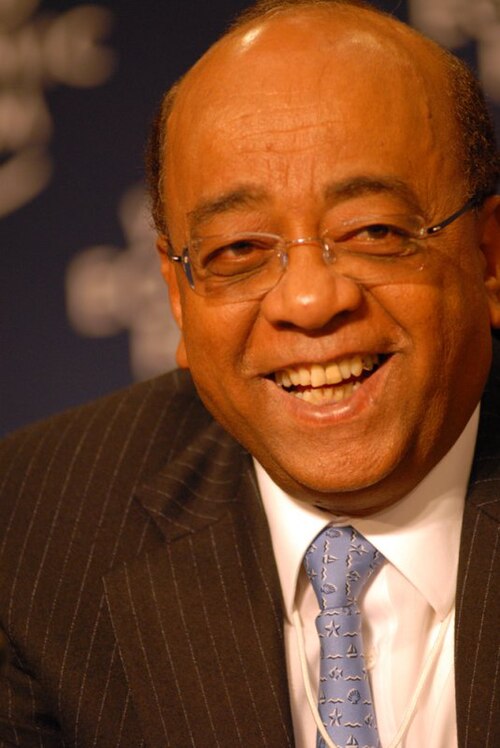
Mo Ibrahim Saw Mobile Networks as Infrastructure Before Much of Africa Had Them
Mo Ibrahim moved from telecommunications engineering to software consulting to building Celtel—one of the companies that helped make mobile connectivity ordinary across African markets.
A technologist before a telecom magnate
Mo Ibrahim’s founder story begins with engineering, not finance. Born in Sudan and educated in electrical engineering, Ibrahim built a career inside telecommunications before starting companies of his own. That technical background shaped the sequence of businesses he created: first expertise and software, then network ownership.
MSI: selling the knowledge before owning the network
In 1989 Ibrahim founded Mobile Systems International, or MSI. The Mo Ibrahim Foundation describes it as a leading cellular consulting and software provider. MSI helped design and support mobile networks at a time when the cellular industry was expanding globally. The business gave Ibrahim an unusually broad view of how networks were built, where they failed, and what operators needed.
The African gap
By the late 1990s, the opportunity in Africa was stark. Large parts of the continent had poor fixed-line service and very low mobile penetration. That could be read as evidence of weak demand. Ibrahim read it differently: the absence of infrastructure created the opportunity for a technology leap. Instead of waiting for landline networks to mature, mobile systems could become the primary communications layer.
Building Celtel
Ibrahim founded Celtel International in 1998. The company expanded mobile operations across multiple sub-Saharan African markets, taking on the difficult work of licenses, towers, power, cross-border operations, and customer acquisition in environments global telecom groups often considered too complex. Contemporary reporting describes Celtel as operating across 13 African countries by the time it was sold in 2005.
A $3.4 billion outcome—and what it represented
In 2005, Kuwait’s MTC acquired Celtel for approximately $3.4 billion. The transaction was a major financial outcome, but the more important story is what had been created underneath it: a working regional network business serving millions of customers in markets that had been treated as commercially marginal. Celtel helped demonstrate that African telecommunications was not a charity case or a speculative frontier. It was a large commercial market.
From networks to governance
After Celtel, Ibrahim redirected much of his attention to the Mo Ibrahim Foundation, established in 2006 to focus on governance and leadership in Africa. That chapter is not a technology startup story, but it is connected to the founder’s earlier experience. Infrastructure businesses operate inside political systems. Licenses, institutions, rule of law, public trust, and governance quality can determine whether private investment compounds or collapses.
Why Africa was not one easy market
Celtel’s achievement should not be flattened into the phrase “Africa was underserved.” Each country brought different licenses, political relationships, currencies, infrastructure conditions and operating risks. Building a regional telecom company meant repeatedly solving those local problems without losing the advantages of a larger network. That is one reason the company’s growth mattered. It showed that a pan-African technology strategy could be more than a presentation slide: it could become an operating company with real customers across multiple jurisdictions.
The builder’s takeaway
Mo Ibrahim’s sequence—engineering, consulting/software, then network ownership—is strategically instructive. A founder does not always have to begin with the capital-intensive version of the opportunity. Expertise can become a wedge. Consulting can expose patterns. Software can reveal operational pain. Once the founder understands the system, the larger infrastructure opportunity may become visible. Ibrahim’s career shows how technical knowledge can become commercial leverage at continental scale.
How the business operates as a technology system
The operating system underneath MSI / Celtel is coordination. The company has to turn many repeated human steps into dependable software without stripping away the judgment users still need. That makes product design, integrations, data quality and workflow reliability strategic—not merely technical implementation details.
What scale changes
At small scale, software can survive rough edges because teams compensate manually. At larger scale, those exceptions become cost centers. Mo’s story is useful because it shows why a technology business has to convert founder intuition into product rules, service systems and infrastructure that work when the founder is not present.
What newer founders should notice
Newer founders should study Mo Ibrahim for the sequence of decisions, not copy the surface form of the company. The transferable question is: what constraint did Mo see that incumbents treated as normal, and what asset did the company build that became harder to replace over time? The answer is usually deeper than branding. It lives in technical capability, distribution, trusted relationships, data, workflow or infrastructure.