Joseph Hawkins
Patented an improved gridiron for cooking
The breakthrough, the technology behind it, the world around it, and the impact that followed.
Why Joseph Hawkins matters
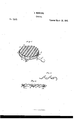
Hawkins matters because technological history is built from both famous breakthroughs and smaller practical inventions that show who was actually participating in technical problem-solving. Hawkins received U.S. Patent No. 3,973 for an improvement in gridirons. The design appears on Henry Baker’s later record of Black inventors, preserving a patent milestone that otherwise could easily disappear from popular history.
The life and career around the milestone
A precise birth date for Joseph Hawkins is not firmly established in the available historical record. The 1845 milestone belongs to the documented arc of the career rather than standing as an isolated date. The life span is listed as Not publicly verified. The clearest documented milestone is patented an improved gridiron for cooking. Uncertain biographical details are left unstated rather than guessed.
What problem the work addressed
The importance is not that a cooking implement changed the entire industrial economy; it is that the surviving patent proves Black inventors were participating in the formal U.S. patent system decades before emancipation. Hawkins received U.S. Patent No. 3,973 for an improvement in gridirons. The design appears on Henry Baker’s later record of Black inventors, preserving a patent milestone that otherwise could easily disappear from popular history.
Inside the technology
A gridiron controls how food is supported and exposed to heat. Mechanical improvements to the frame, support and handling of cooking equipment were practical technologies in a period before modern ranges and standardized kitchen appliances. Agricultural and food technology is unforgiving of fragile ideas. Irregular materials, moisture, dirt, continuous use, and the need to save labor expose weak mechanisms quickly. Seen that way, Joseph Hawkins’s work in Cooking technology + mechanical design is about process control: turning a repeated physical task into something faster, more consistent, safer, or easier to operate.
The dated record
The timeline is anchored by March 26, 1845 · U.S. Patent No. 3,973. Those dates matter because the contribution developed across more than one documented step rather than appearing as a single frozen moment. No separate company or launch year is stated unless it is supported by the historical evidence. A patent, experiment, or institutional contribution is evidence of technical work; it is not automatically evidence of mass production or commercial success.
From technical work to real-world use
Patent evidence is especially useful in Joseph Hawkins’s story because it fixes a technical claim to a date and, when drawings survive, shows how the inventor described the mechanism. Hawkins’s name became part of the historical record reconstructed by patent examiner Henry Baker, whose work remains one of the most important sources for early African American patent history. A patent still has limits as historical evidence: it does not by itself establish production volume, sales, wealth, or exclusive authorship of every later version of the idea. It documents technical work without implying a broader business claim.
The historical setting
The 1845s sit before the end of the Civil War, in a United States structured by slavery and severe restrictions on Black legal, educational, and economic opportunity. That broad setting does not prove a specific undocumented hardship in Joseph Hawkins’s personal life, but it explains why surviving technical records from Black practitioners are unusually important. Almanacs, patents, advertisements, government files, and later institutional biographies often carry more weight than a conventional archive would for a better-documented inventor.
What changed because of the work
The importance is not that a cooking implement changed the entire industrial economy; it is that the surviving patent proves Black inventors were participating in the formal U.S. patent system decades before emancipation. Hawkins’s name became part of the historical record reconstructed by patent examiner Henry Baker, whose work remains one of the most important sources for early African American patent history. Taken together, those two pieces show why the milestone matters beyond biography. The first explains the constraint or opportunity; the second shows the change in capability, practice, infrastructure, or recognition that followed. That connection is what turns a dated achievement into technology history rather than a list of names.
What the record says—and what it does not
One of the most useful facts in the record is this: The USPTO lists Hawkins’s patent among the early entries on Baker’s list. When a celebrated ‘first’ claim is broader than the evidence safely supports, the narrower documented claim is the stronger history.
Why the technology still matters
The artifact may belong to another era, but the engineering pattern is current. A gridiron controls how food is supported and exposed to heat. Mechanical improvements to the frame, support and handling of cooking equipment were practical technologies in a period before modern ranges and standardized kitchen appliances. Modern products still win or fail on the same practical questions: does the design reduce friction, risk, time, cost, or error, and can other people use it reliably? Joseph Hawkins’s exhibit is valuable because it lets readers see those design questions before today’s vocabulary existed.
A lesson for builders now
For builders, the most transferable lesson is to study the constraint before admiring the artifact. Joseph Hawkins’s documented milestone was to patented an improved gridiron for cooking. The importance is not that a cooking implement changed the entire industrial economy; it is that the surviving patent proves Black inventors were participating in the formal U.S. patent system decades before emancipation. A strong product strategy starts the same way: identify the failure, bottleneck, or exclusion clearly enough that the design decision becomes obvious in hindsight.
The legacy in one clear line
The strongest way to remember Joseph Hawkins is specific: Patented an improved gridiron for cooking. Hawkins matters because technological history is built from both famous breakthroughs and smaller practical inventions that show who was actually participating in technical problem-solving. The strongest legacy is the specific, documented contribution itself.